An Introduction to Cosmology
What is Cosmology?
The science of asking the most unreasonable questions imaginable, and actually getting answers.
Go outside on a clear night and look up. Every point of light you see is a star inside our own galaxy, the Milky Way. But beyond those stars, if your eyes were powerful enough, you would see something staggering: roughly two trillion galaxies, each containing hundreds of billions of stars, spread across a universe about 93 billion light years wide.
Cosmology is the science of all of that: how it began, what it is made of, and where it is going. What makes it unusual is that we can actually answer these questions, with remarkable precision, by combining theory, observation, and increasingly clever data analysis. This page is an attempt to build up that understanding from scratch.
The Universe is Expanding, and Light Tells Us This
When space stretches, light stretches with it. That shift in colour is our speedometer for the cosmos.
In 1929, Edwin Hubble noticed something strange: almost every distant galaxy has its light shifted toward the red end of the spectrum. Not because galaxies are all rushing away from us specifically, but because the space between us and them is stretching. And as space stretches, any light wave travelling through it gets stretched too, its wavelength grows longer, shifting toward red. We call this cosmological redshift.
The animation below shows exactly this. A galaxy emits light at a specific wavelength (its colour). As the universe expands (drag the slider), that wave is stretched. The same physical process tells us the universe had a beginning: run the expansion backward and everything converges.
The rate of expansion is parameterised by the Hubble constant H₀. It tells you how fast two points in space are moving apart per unit of distance between them. Measuring it precisely turns out to be one of the hardest problems in observational cosmology, and there is currently a serious disagreement between different measurement methods.
A Brief History of Everything
Run the expansion backward and you get a universe that was once unimaginably hot and dense.
If the universe is expanding now, it was smaller and denser in the past. And smaller means hotter, just like compressing a gas heats it up. Wind the clock back 13.8 billion years and you reach a state so extreme that ordinary matter could not exist: no atoms, no nuclei, just a soup of fundamental particles and radiation.
As the universe cooled through its expansion, it passed through a series of transitions, each one leaving observable signatures we can still measure today. The wedge below shows the universe growing from a point at the Big Bang (left) to its present size (right). The dot of light travelling from the moment of recombination to today represents the CMB photons reaching us right now.
The CMB: the First Light of the Universe
The universe was once so hot that light could not travel. What changed, and what can that ancient light tell us?
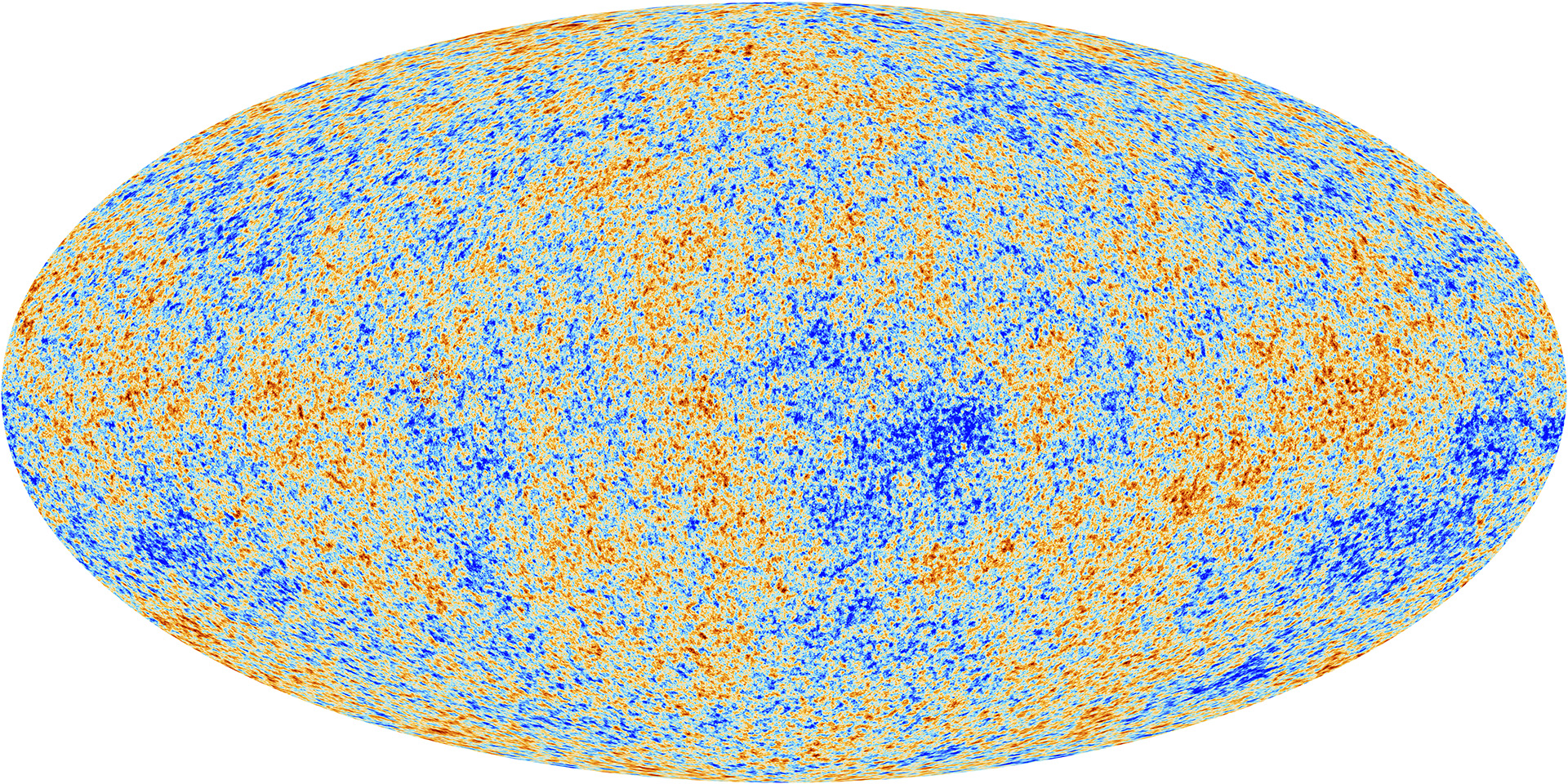
From the pattern of temperature fluctuations in the CMB, with their angular scales and amplitudes, we can extract six numbers that completely specify the universe: its age, geometry, and the densities of ordinary matter, dark matter, and dark energy. This is what the Planck and WMAP satellites were built to measure.
Inflation: Solving the Horizon Problem
Why does the CMB look the same in every direction, even from regions that should never have communicated?
The CMB temperature is uniform across the entire sky to one part in 100,000. But here is the puzzle: in standard Big Bang cosmology (without inflation), two points on opposite sides of the CMB sky have never been in causal contact. Light simply did not have enough time to travel between them before the CMB was released. So how do they know to be the same temperature?
Inflation solves this by proposing that the entire observable universe originated from a tiny patch that was in causal contact, and then that patch was stretched by a factor of at least 10²⁶ during a brief burst of exponential expansion. The animation below illustrates the difference.
What the Universe is Made Of
Everything you have ever seen, stars, planets, people, is about 5% of the universe.
How Structure Formed: Gravity Amplifying Whispers
The early universe was almost perfectly smooth. Almost.
The CMB is uniform to one part in 100,000. But that tiny nonuniformity is everything. Regions that were even slightly denser than average pulled in surrounding matter through gravity, becoming denser still. Regions that were slightly emptier became emptier still. Over 13.8 billion years, these whisper quiet fluctuations were amplified by gravity into the spectacular web of galaxies and voids we observe today.
Dark matter was essential to this. Because it does not interact with radiation, it started clustering before ordinary matter could, building gravitational wells that baryons later fell into. Without dark matter, there would not have been enough time to grow the structures we see.
The video below shows a cosmological N body simulation, hundreds of thousands of dark matter particles evolving under gravity from a nearly uniform start. Watch the cosmic web assemble itself: thin filaments connecting dense nodes, with vast empty voids in between. This is exactly what we observe when we map the large scale structure of the real universe.
What We Do Not Know
Cosmology is not a finished subject. It is in productive crisis.
The Hubble Tension
The expansion rate H₀ measured from the CMB (early universe) disagrees with measurements from Cepheid stars and supernovae (local universe) at around 5σ. This is either a systematic error in one or both methods, or a crack in the standard model.
What is Dark Matter?
We have overwhelming indirect evidence for dark matter. Dozens of direct detection experiments have found nothing. The original WIMP candidate is increasingly constrained. Axions, sterile neutrinos, and primordial black holes remain active targets.
What is Dark Energy?
The cosmological constant fits all data, but its predicted magnitude from quantum field theory is wrong by 120 orders of magnitude. Whether it is truly constant or slowly evolving (dynamical dark energy) is one of the central questions for Euclid and future surveys.
The σ₈ Tension
Weak gravitational lensing surveys consistently find slightly less clustering than the CMB predicts under ΛCDM. The discrepancy is at 2 to 3σ. It could point to new physics in the growth of structure, or to systematic effects not yet fully understood.
What Drove Inflation?
Inflation solves real problems elegantly. But the inflaton field has no confirmed particle physics realisation. Detecting a primordial gravitational wave signal in the CMB polarisation (the B-mode signal) would be the clearest evidence for inflation.
Why is There Something?
The Big Bang should have created equal amounts of matter and antimatter. They would have annihilated, leaving nothing. Yet here we are. The observed matter antimatter asymmetry is unexplained within the Standard Model, one of the deepest puzzles in all of physics.
References & Further Reading
- Planck Collaboration (2020). Planck 2018 results VI: Cosmological parameters. A&A 641, A6. arXiv:1807.06209
- Verde, L., Treu, T., & Riess, A. G. (2019). Tensions between the early and late universe. Nature Astronomy 3, 891. arXiv:1907.10625
- Riess, A. G. et al. (2022). A comprehensive measurement of the local value of the Hubble constant. ApJL 934 L7. arXiv:2112.04510
- Di Valentino, E. et al. (2021). In the realm of the Hubble tension: a review of solutions. CQG 38, 153001. arXiv:2103.01183
- Weinberg, S. (2008). Cosmology. Oxford University Press. A comprehensive graduate level reference.
- Dodelson, S. & Schmidt, F. (2020). Modern Cosmology, 2nd ed. Academic Press. Clear and up to date.
- Baumann, D. Cosmology lecture notes. University of Cambridge. cosmology.amsterdam. Freely available and an excellent introduction.
- Peebles, P. J. E. (1993). Principles of Physical Cosmology. Princeton University Press.
- Aghanim, N. et al. / Planck Collaboration (2020). Planck 2018 results I: Overview. A&A 641, A1. arXiv:1807.06205
- Euclid Collaboration (2024). Euclid. I. Mission overview. A&A 697, A1. arXiv:2405.13491
- NASA / WMAP Science Team. What is the universe made of? map.gsfc.nasa.gov
- ESA / Planck Collaboration (2013). Planck CMB all-sky map. esa.int. CMB temperature anisotropy map used in this page under ESA standard image use policy.
- Deep Astronomy. How The Universe Was Formed [video]. YouTube, 2014. youtube.com/watch?v=s43lkwCsPPg. Used via YouTube standard embed.